The Quiet Side of the Front: Extra Vigilance Required in the United States for the Upcoming Midterm Elections
The title of this article comes from a battlefield lesson I associate with Gen. James Mattis’s writing about combat: when the enemy is making noise on one side of the perimeter, a commander still has to ask what is happening on the quiet side.
That question feels increasingly relevant at home.
For much of the last several years, Americans watching Russia’s war against Ukraine have become familiar with an entirely new rhythm of warfare. Air-raid alerts. Waves of inexpensive one-way attack drones. Critical infrastructure struck hundreds of miles behind a front line. Air defenses forced to expend considerable resources against relatively inexpensive weapons. Civilians learning to distinguish the sound of an approaching drone from ordinary background noise.
For Americans, that remains something that happens somewhere else.
That assumption deserves examination.
The United States does not currently have a conventional front line. We have two oceans, large borders, an enormous civil aviation system, dense coastal population centers, distributed critical infrastructure, thousands of state and local government facilities, and a population largely unaccustomed to thinking about aerial attack.
Long-range unmanned systems are changing what those geographic advantages mean.
This does not mean HybridSec has evidence that somebody is preparing a drone campaign against the United States.
We do not.
It means the capability now exists, the U.S. government itself recognizes malicious UAS as a significant homeland-security problem, and the consequences of being surprised are sufficiently serious that preparedness should begin before evidence of an attack appears.
That distinction matters.
Key Judgments
The malicious UAS threat to the U.S. homeland is real. U.S. Northern Command states that small drones have emerged as a significant risk to infrastructure and safety inside the United States. USNORTHCOM has been designated the Department of Defense lead synchronizer for homeland counter-small-UAS operations and is actively experimenting with detection, tracking, identification, and mitigation capabilities.
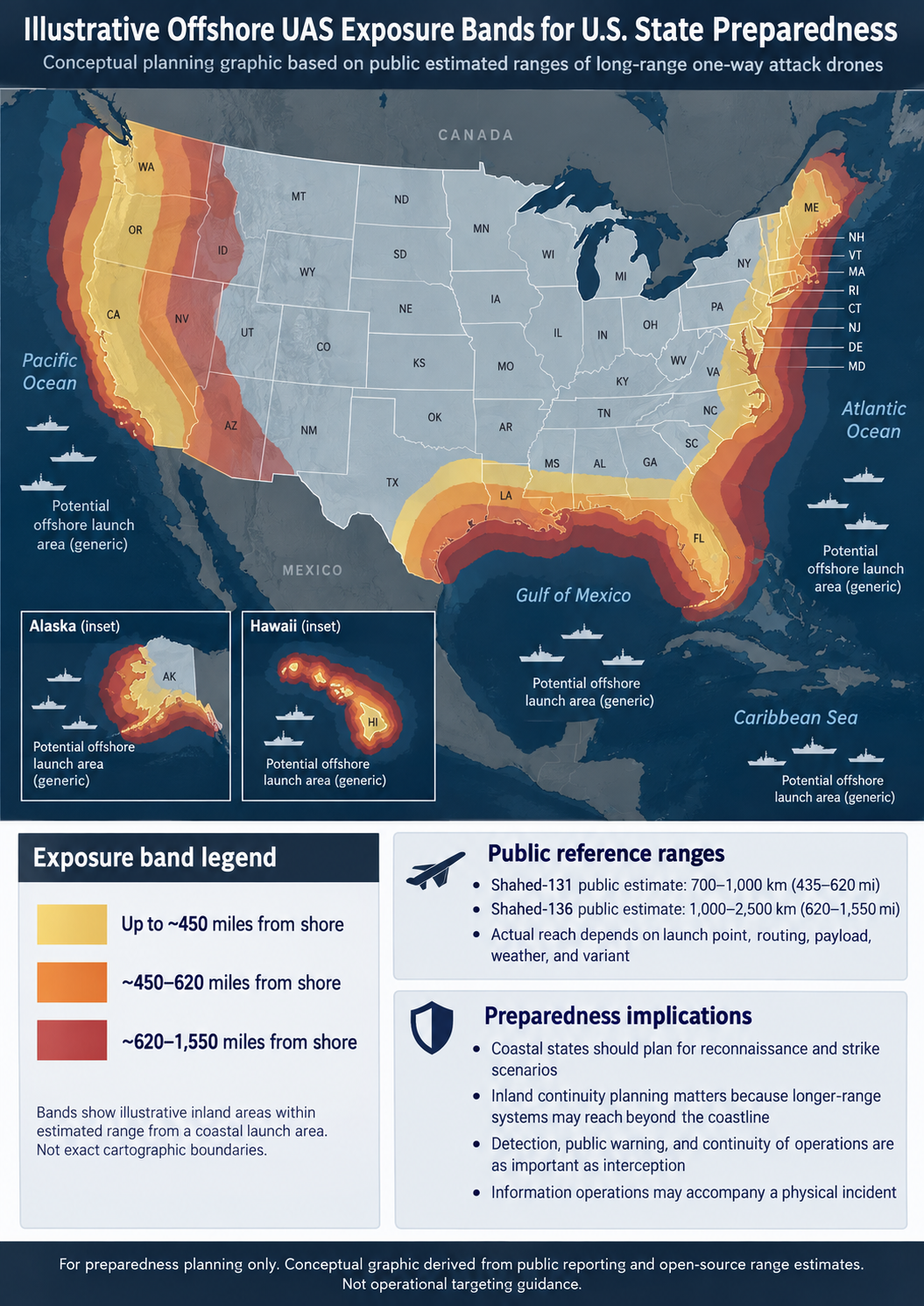
The technology has changed the geography of the problem. Public estimates collected by the Center for Strategic and International Studies place the Shahed-131 family at roughly 700–1,000 kilometers of range and the larger Shahed-136 at roughly 1,000–2,500 kilometers. CSIS also notes that variants of these systems can use mobile launch mechanisms, including maritime platforms. Those estimates vary substantially by configuration, payload, routing, weather, and variant, but even the lower figures are strategically important.
A maritime-launched attack against the United States is technically plausible. Plausibility, however, is not the same thing as evidence of preparation. HybridSec has identified no public evidence establishing that a coordinated offshore drone campaign against U.S. cities or election infrastructure is currently being prepared.
The election period increases the potential consequence of any ambiguous physical incident. The next regularly scheduled federal general election is November 3, 2026. Election administrators are already expected to prepare for cyber, physical, communications, and influence-related disruptions. A novel aerial incident during that period could create effects well beyond whatever physical damage occurred.
The appropriate response is preparation, not prediction.
Confidence in these judgments is Moderate. The capabilities and existing homeland UAS concerns are well documented. Intent toward the specific scenario examined here is not.
Range Changes the Conversation
The lead graphic is deliberately simple.
Start with the coastline and move inland.
A system with a range measured in hundreds of miles makes coastal infrastructure relevant.
A system with a range approaching 1,000 miles makes much of the eastern, western, and southern United States relevant.
At the upper end of public Shahed-136 estimates, the phrase coastal state becomes a poor description of the potential planning problem. Significant portions of inland America could theoretically fall within the reach of a sufficiently positioned long-range platform.
Again, these are not attack predictions.
They are geometry.
And geometry matters because government planning boundaries have traditionally followed jurisdiction more readily than emerging weapons do.
A governor does not need intelligence identifying an imminent attack before asking whether state emergency management, law enforcement, election officials, utilities, hospitals, transportation authorities, communications providers, and the National Guard have thought through a coordinated UAS incident.
We conduct earthquake exercises without predicting the date of an earthquake.
We prepare for hurricanes before knowing precisely where they will make landfall.
We build cyber incident-response plans without evidence that a particular ransomware group has selected us as its next target.
The same logic should apply here.
This Is No Longer Entirely a Foreign Battlefield Problem
There is an understandable temptation to describe weaponized drones as a lesson from Ukraine or the Middle East.
That framing is increasingly incomplete.
USNORTHCOM’s homeland counter-UAS mission exists precisely because American defense officials believe the domestic problem has changed. Its current work includes coordinating detection and defensive capabilities across hundreds of military installations. In September 2026, USNORTHCOM and DHS publicly described efforts to improve interagency protection of U.S. critical infrastructure from small-UAS threats.
The threat is not limited to nation-states.
In June 2026, the Department of Justice announced arrests arising from an alleged domestic plot in which conspirators discussed procuring and flying explosive-laden drones against a high-profile event in Washington. Those charges remain allegations unless proven in court, but the case demonstrates why weaponized-drone scenarios can no longer be dismissed as purely theoretical within the United States.
CISA likewise maintains a dedicated Be Air Aware program for managing UAS risks to critical infrastructure and public gatherings.
None of these facts establish our maritime scenario.
They establish something more basic:
The underlying problem is real enough that institutions responsible for protecting the homeland are already reorganizing around it.
Why the Midterm Election Matters
There is nothing magical about November 3.
A power station hit in July is still a power station hit.
A communications outage in January is still a communications outage.
The election changes the information environment surrounding an incident.
Imagine that a significant UAS event occurs somewhere in the United States during the final week before voting.
At first, attribution is unknown.
A video appears online.
Then another.
Someone claims a second attack occurred in another state.
Maybe it did. Maybe it did not.
Images circulate purporting to show additional drones.
A foreign intelligence service amplifies one explanation. Domestic political accounts amplify another. Someone produces an AI-generated video. False evacuation notices appear. News organizations attempt to verify rapidly changing claims while government investigators are still examining physical evidence.
Within an hour, millions of Americans may believe they know who attacked them.
The people actually investigating may still know very little.
That gap between public certainty and evidentiary certainty is exploitable.
CISA already treats crisis communications, physical security, cyber disruption, artificial intelligence, foreign malign influence, bomb threats, emergency communications, and continuity planning as election-security concerns. Its election tabletop program exists specifically so jurisdictions can rehearse disruptive scenarios before Election Day.
UAS should now be included in that conversation.
Not because we know an attack is coming.
Because an attack would arrive inside an unusually combustible information environment.
The Physical Attack Might Not Be the Main Event
This is where the quiet-side-of-the-front idea becomes useful.
A drone carries a finite payload.
The information environment does not.
An adversary interested primarily in destabilization may value the secondary effects of an incident at least as much as the physical effects.
Fear.
Conflicting attribution.
Emergency closures.
Interrupted transportation.
Distrust of government statements.
False reports of additional attacks.
Questions about whether polling locations can safely operate.
Claims that voting systems were affected when they were not.
Claims that unaffected jurisdictions are compromised.
Fabricated government documents.
Synthetic audio purporting to come from public officials.
The objective would not necessarily need to be stopping an election.
Creating sufficient uncertainty around the election could itself have strategic value.
That is an analytical hypothesis, not an attribution judgment.
There is currently no public evidence connecting a planned drone campaign to the 2026 election.
But resilience planning should consider second- and third-order effects before an incident occurs.
The United States Has Another Vulnerability: Normalcy
The overwhelming majority of drone flights in America are lawful.
That is important.
The Northeast drone episode in late 2024 demonstrated how quickly ambiguous sightings can grow into a national narrative. Federal authorities investigated thousands of reports and ultimately stated that they had not identified anomalous activity presenting a national-security or public-safety risk in civilian airspace.
That episode teaches two seemingly contradictory lessons.
First, unusual drone reports cannot automatically be dismissed.
Second, unusual drone reports cannot automatically be believed.
Both failures create opportunities for an adversary.
A population conditioned to dismiss every report as hobbyist activity can be surprised.
A population conditioned to interpret every light in the sky as an attack can be manipulated.
The answer is better sensing, reporting, analysis, and communication.
It is not panic.
What State Governments Can Do Before November 3
States do not need to become air-defense commands. They need to understand their role in a layered national system and ensure that the organizations responsible for continuity, emergency response, law enforcement, elections, infrastructure, and public communication know how they will work together.
A useful state-level review could begin with seven questions:
-
Who owns the UAS picture? Determine how suspicious UAS reporting moves from local law enforcement and infrastructure operators into state fusion centers, emergency management, federal law enforcement, FAA channels, and other appropriate federal partners.
-
What must continue operating? Identify critical government, communications, healthcare, energy, transportation, public-safety, and election functions whose disruption would generate cascading effects, then examine continuity requirements rather than trying to predict specific targets.
-
Who has legal authority to do what? Counter-UAS operations sit inside a complicated legal and aviation-safety framework. The 2026 SAFER SKIES implementation created a federal framework through which qualifying state, local, tribal, and territorial law-enforcement agencies can conduct authorized C-UAS operations subject to training, certification, approved technologies, airspace coordination, reporting, and other requirements. That is not a blanket license to jam, seize, or destroy aircraft.
-
Can election operations continue through a physical disruption? Election officials should examine alternate communications, facility access, emergency relocation procedures, coordination with public safety, and public-information processes alongside their existing cyber planning.
-
Can the state communicate under uncertainty? Officials should have preapproved mechanisms for saying what is confirmed, what remains unknown, what the public should do, where authoritative information will appear, and when the next update will occur.
-
Can responders distinguish one event from a campaign? A common operating picture should allow analysts to determine whether multiple reports share meaningful characteristics or are simply unrelated events occurring in a country where millions of legitimate drones and aircraft are operating.
-
Has the state exercised the problem? Run a tabletop combining a confirmed UAS incident, ambiguous follow-on reports, a communications outage, conflicting social-media claims, and election-continuity decisions. Make participants operate with incomplete information. That is the environment they would actually face.
These are achievable steps.
None requires knowing that an attack is imminent.
Detection Is Not Attribution
This deserves its own warning.
A sensor detecting an object does not tell us why it is there.
The FAA explicitly notes that detection systems by themselves cannot determine the intent or threat level of a UAS.
That distinction is critical for any future incident.
Detection: Something is in the air.
Identification: We have characterized the object.
Behavior: We understand what it appears to be doing.
Attribution: We have evidence connecting it to an operator.
Intent: We have evidence explaining why the operator acted.
Those are different analytical steps.
Compressing them into a single conclusion is how intelligence failures happen.
It is also how disinformation succeeds.
What Would Change Our Assessment
HybridSec should be explicit about this.
Our concern would increase materially if credible reporting began showing technically confirmed UAS reconnaissance around similar categories of infrastructure in multiple states; common technical characteristics linking geographically separated incidents; seizures or arrests connecting people, equipment, or logistics networks across jurisdictions; credible maritime-security reporting involving suspicious UAS activity; cyber reconnaissance or intrusion activity directed at the same sectors experiencing physical surveillance; or coordinated information operations appearing to anticipate physical incidents.
Our concern would decrease if reported activity consistently resolved into lawful civil aviation, unrelated commercial drone activity, sensor artifacts, misidentification, or isolated criminal behavior without evidence of broader coordination.
The purpose of identifying those indicators now is to prevent ourselves from rewriting the hypothesis after every new event.
Evidence should change the theory.
The theory should not change the evidence.
The Quiet Side of the Front
The United States is fortunate.
We are geographically difficult to attack conventionally.
That advantage is real.
It is not permanent.
Technology continuously renegotiates geography.
Cyber operations did it to networks.
Commercial satellite systems did it to intelligence collection.
Long-range precision weapons did it to battlefields.
Cheap autonomous and semi-autonomous systems are doing it to airspace.
The important question is therefore not:
Are Shahed-style drones coming for American cities?
We currently have no evidence that they are.
The better question is:
If someone eventually tries, what will we wish we had done beforehand?
For state governments, the answer should begin with recognizing that the scenario is possible.
Then map responsibilities.
Build communications.
Understand authorities.
Protect continuity.
Exercise the problem.
Teach people how to report what they see without creating panic.
Prepare officials to communicate when attribution is uncertain.
And make sure the agencies responsible for protecting democratic processes can continue operating while investigators determine what actually happened.
That is vigilance.
It does not require fear.
It requires imagination before crisis.
The guns are loud elsewhere in the world right now.
We should still be looking at the quiet side of our own front.
Confidence and Sourcing
Overall confidence: Moderate.
There is high confidence that malicious and weaponized UAS represent a growing homeland-security concern and that long-range one-way attack systems can operate at distances relevant to U.S. preparedness planning. These judgments are supported by U.S. government statements, operational counter-UAS programs, documented foreign employment of such systems, and publicly reported technical characteristics.
There is low confidence in any claim that a maritime-launched, coordinated UAS campaign against the United States is currently being prepared around the 2026 midterm election. HybridSec has identified no public evidence establishing such a plot.
The distinction between those two conclusions is the central point of this assessment.
References
U.S. Northern Command. Homeland Counter-Small Unmanned Aircraft Systems. Current USNORTHCOM mission description and Falcon Peak 26.2 information.
U.S. Northern Command. USNORTHCOM and DHS leaders strengthen interagency collaboration to safeguard the United States. September 10, 2026.
Cybersecurity and Infrastructure Security Agency. Be Air Aware. UAS threat and preparedness resources for critical infrastructure and public gatherings.
Cybersecurity and Infrastructure Security Agency. Election Security Training. Election physical security, crisis communications, AI/foreign influence, emergency communications, and tabletop resources.
Federal Election Commission. Election and Voting Information. November 3, 2026 federal general-election date.
Center for Strategic and International Studies, Missile Defense Project. Shahed-131 and -136. Updated June 2, 2026.
U.S. Department of Justice. June 22, 2026 charging announcements concerning an alleged plot involving explosive-laden drones. Criminal charges are allegations unless proven in court.
Department of Homeland Security and Department of Justice. Counter-UAS Authority for State, Local, Tribal, and Territorial Law Enforcement and Correctional Agencies. Interim final rule implementing the SAFER SKIES Act, effective July 1, 2026.
Federal Aviation Administration. UAS Detection, Mitigation, and Response on Airports. Guidance concerning UAS detection, threat determination, and mitigation authorities.
Share this article

yankee0one
Former documentary junky turned pilot, turned sailor, turned cyborg
Related Articles

25 Years Later: Reflections from a GWOT Combat Veteran
On the 25th anniversary of September 11, a GWOT combat veteran reflects on service, sacrifice, solidarity, and our shared responsibilities as free people.
Read more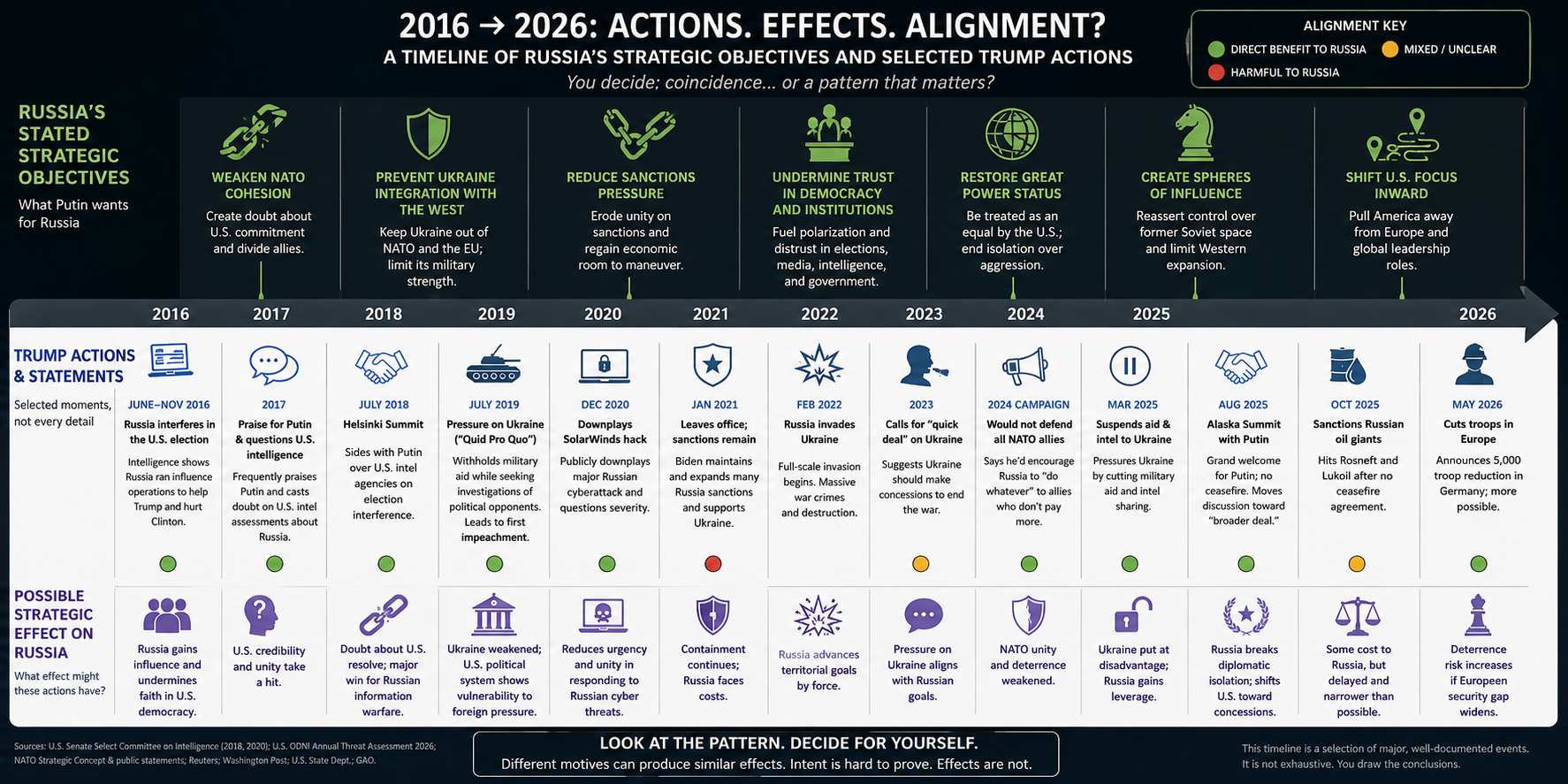
U.S. Decisions and Russian Objectives: Assessing Strategic Effects
An assessment of selected U.S. decisions, their documented effects, and where those effects align with Russian objectives, with counterexamples and limits.
Read more
Drone Swarms and the Changing Cost of Warfare
How coordinated drones can change reconnaissance, defense costs, logistics, and command decisions, with limits to the gunpowder analogy.
Read more