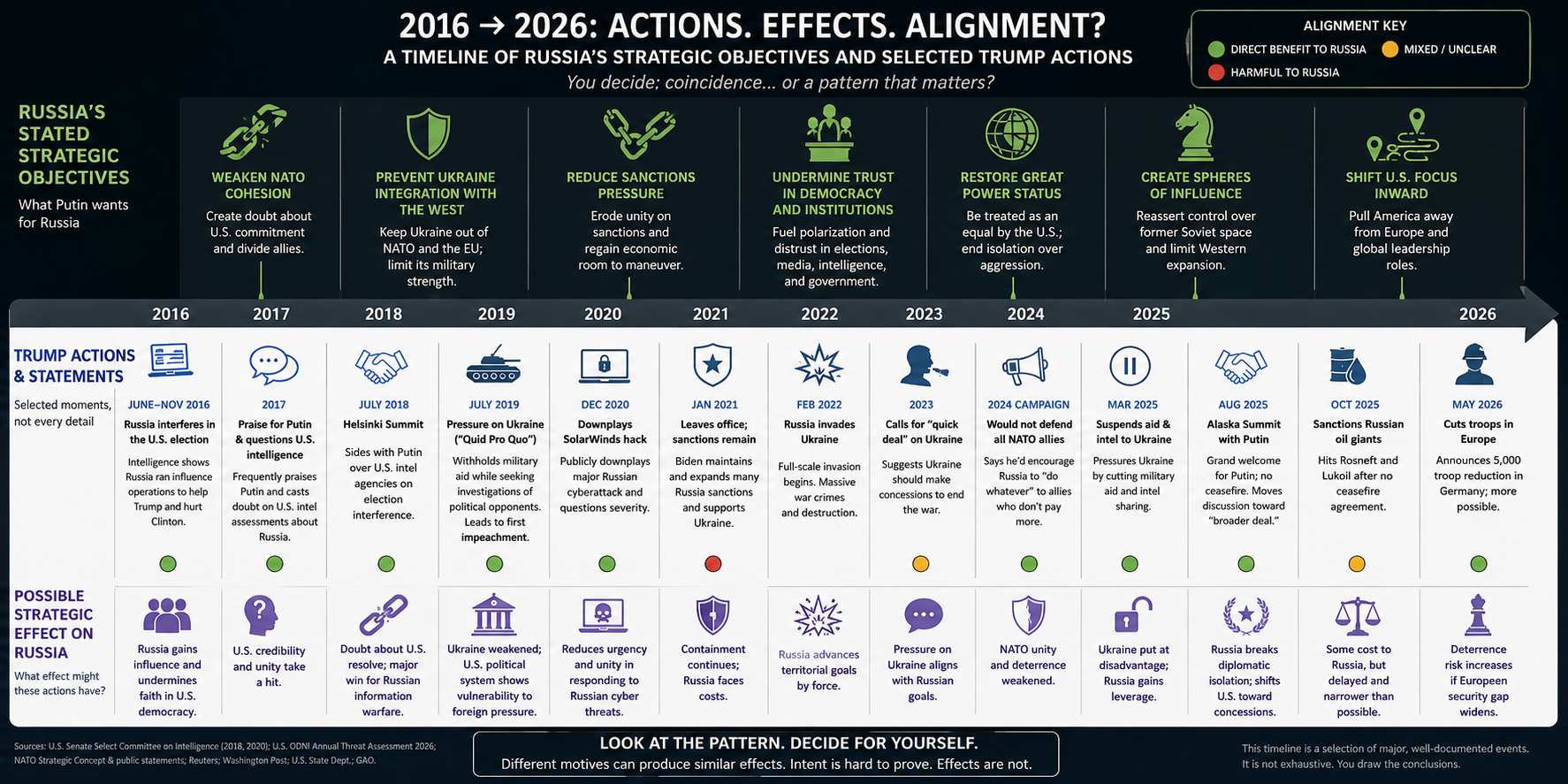
Analytic note: The timeline above is an argument rendered as an infographic. It combines documented events with judgments about their possible strategic effects. Its alignment ratings do not establish motive, coordination, conspiracy, or causation. The final May 2026 entry, an asserted 5,000-troop reduction in Germany, was not corroborated in the official sources reviewed for this article and should be treated as an unresolved claim rather than a confirmed fact.
Separate the action from its purpose
A policy can benefit an adversary for reasons unrelated to that adversary’s preferences. It can also have cumulative effects worth examining even when each decision has a plausible domestic explanation.
The question I want to examine is whether separate actions repeatedly produce effects that align with Russia’s stated strategic objectives. If they do, the pattern may identify a risk worth addressing. Establishing why the decisions were made requires additional evidence.
The distinction matters. Motive describes why a decision was made. Effect describes what the decision changed. Alignment describes whether that effect advances another actor’s objectives. Those are three different analytic claims with three different evidentiary burdens.
Establish Russia’s objectives
The U.S. Intelligence Community’s 2026 Annual Threat Assessment provides a useful baseline. It assesses that Russia seeks a multipolar order in which it holds a privileged position equal to other great powers, wants to restore a sphere of influence, and opposes further NATO expansion in the former Soviet space, especially Ukraine.
NATO’s own strategic materials describe the same contest from the Alliance perspective. NATO says Russia uses conventional, cyber, and hybrid means to establish spheres of influence, while the Alliance maintains that sovereign states retain the right to choose their security arrangements. NATO also identifies Russia as the most significant direct threat to Allied security in its current Strategic Concept.
That establishes the strategic comparison used by the timeline:
- weaken NATO cohesion and confidence in collective defense;
- prevent Ukraine’s durable integration with Western institutions;
- reduce or fracture sanctions pressure;
- erode trust in democratic institutions;
- restore recognition of Russia as a great power;
- rebuild influence over neighboring states; and
- redirect U.S. attention and resources away from Europe.
These objectives overlap and reinforce one another. A weaker NATO makes coercion around Russia’s periphery easier. A divided American public reduces policy continuity. Reduced support to Ukraine improves Moscow’s leverage on the battlefield and at the negotiating table. None of those effects requires a single hidden plan to be strategically meaningful.
What the record establishes
The following examples retain the sources and scope of the August 2026 assessment. They establish particular events and, in some cases, reported effects. The selected timeline is not a complete dataset of U.S. policy.
The bipartisan Senate Intelligence Committee concluded that Russia conducted an aggressive, multifaceted effort to influence the 2016 election. Its reports documented cyber operations, social-media manipulation, and efforts to exploit American political divisions. Acting chairman Marco Rubio characterized the investigation as finding no evidence of campaign collusion in his statement accompanying the final volume. That characterization should be attributed to Rubio rather than presented as a unanimous conclusion of the report. The documented interference provides context; it does not make every subsequent policy decision evidence of coordination.
The 2019 withholding of congressionally appropriated Ukraine security assistance is also a matter of official record. The Government Accountability Office concluded that the Office of Management and Budget violated the Impoundment Control Act by withholding approximately $214 million for policy reasons. The domestic legal finding does not itself prove a Russian strategic purpose. It does show that support intended to strengthen Ukraine was delayed.
The March 2025 pause in military assistance is documented in the Defense Department inspector general’s Operation Atlantic Resolve report. Assistance stopped from March 3 to March 11. A subsequent quarterly report said the pause adversely affected Ukrainian operational capabilities and weakened Kyiv’s negotiating position. That is a documented strategic effect, irrespective of the administration’s stated purpose.
The August 2025 Alaska meeting is likewise not speculative; the White House documented the summit between Presidents Trump and Putin. Whether the summit increased Russian prestige, created diplomatic opportunity, or did both is an analytic judgment. Diplomacy with an adversary is not inherently capitulation. But ceremonial treatment, agenda control, sequencing, and whether negotiations produce reciprocal concessions are legitimate variables in a net assessment.
The timeline also marks a counterexample: October 2025 sanctions against Rosneft and Lukoil. Treasury described the action as an effort to increase pressure on Russia’s energy sector and reduce revenue available to the Kremlin’s war machine. The official designation is evidence that the record is not uniformly beneficial to Moscow. Retaining this counterexample helps test whether the proposed pattern fits the record.
Read the map as a metaphor
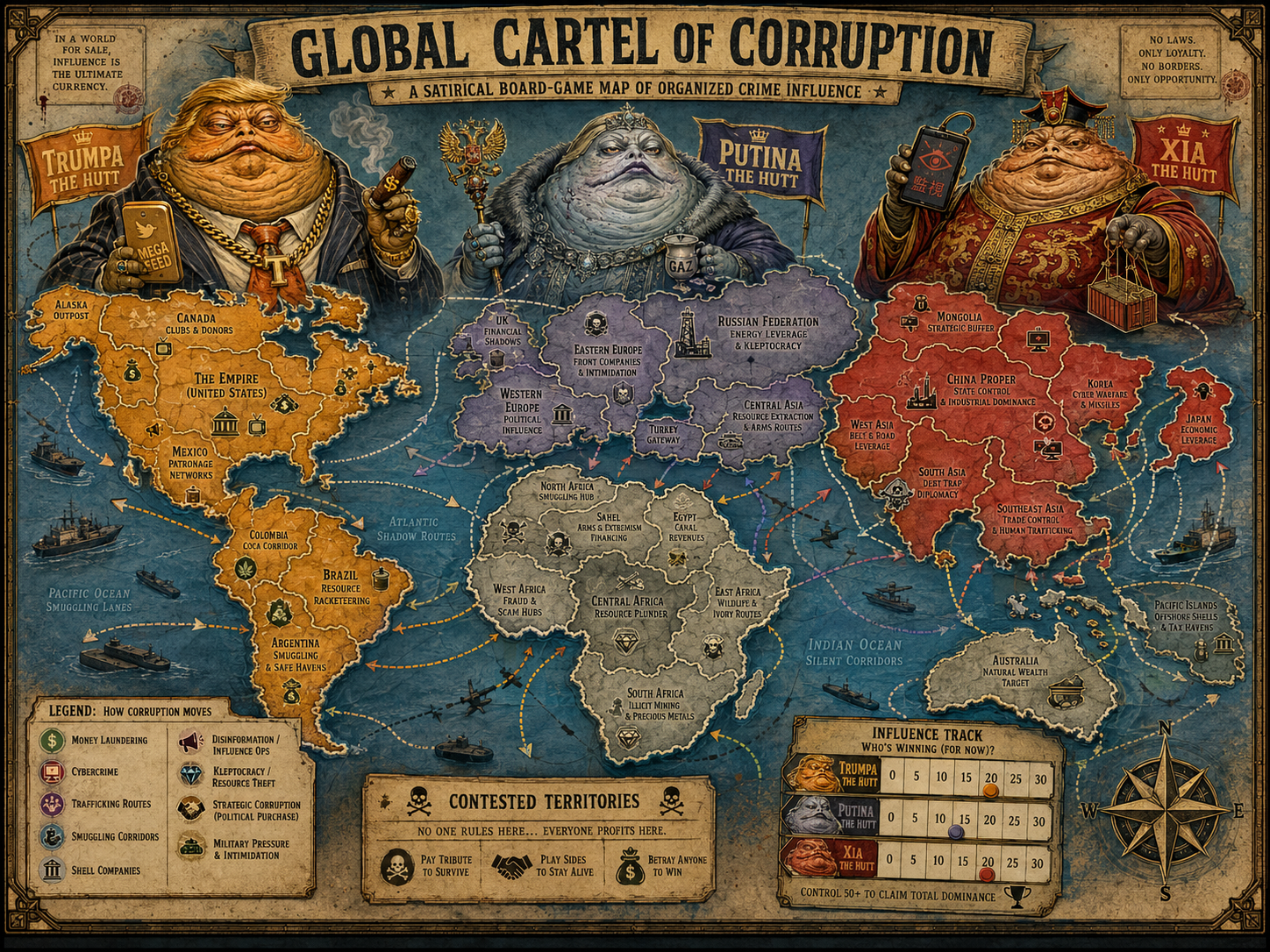
The “Global Cartel of Corruption” image is political satire. Its caricatures and labels are rhetorical devices, not findings of criminal conduct, intelligence attribution, or evidence that the depicted people and states form a literal cartel.
The map is useful only if read as a systems metaphor. It compresses money laundering, shell companies, resource theft, cyber operations, trafficking, disinformation, and political influence into a single board. In reality, these activities do not operate under one command structure. They form overlapping markets and networks in which state services, oligarchs, corporations, intermediaries, criminal organizations, and opportunists sometimes cooperate, sometimes compete, and often exploit the same infrastructure.
Corruption can connect a domestic governance failure to an external security vulnerability. The mechanism deserves investigation in each case.
Opaque ownership can hide sanctions evasion. Political finance can purchase access without requiring ideological loyalty. Illicit logistics can move weapons, people, commodities, and intelligence through the same corridors. Disinformation can protect those arrangements by overwhelming the public with incompatible explanations until accountability feels impossible.
The map suggests more coherence than the evidence establishes. Its useful question is whether separate networks can produce aligned outcomes through shared incentives and infrastructure.
Test the proposed alignment
These tests separate the underlying event from the interpretation placed on it.
1. Establish the adversary’s objective independently
Do not infer Russia’s goals from the American action being evaluated. Use doctrine, official intelligence assessments, observed force posture, sanctions behavior, diplomatic demands, and repeated state messaging.
2. Identify the measurable effect
Did the decision alter weapons delivery, readiness, alliance confidence, sanctions enforcement, negotiating leverage, public trust, or force posture? A rhetorical controversy is not automatically a strategic effect.
3. Compare stated purpose with observed result
A policy can have a legitimate purpose and still generate exploitable consequences. Strategy requires examining both. Intent does not cancel effect; effect does not prove intent.
4. Search for disconfirming evidence
The 2025 oil sanctions matter because they cut against a simple theory of continuous accommodation. So do continued sanctions in 2021 and other measures not represented in the selected timeline. A graphic that says “selected moments” is necessarily incomplete.
5. State confidence and its basis
“Direct benefit,” “mixed,” and “harmful” are conclusions that should carry confidence levels and sourcing. Analysts should be especially cautious when an event is recent, negotiations are incomplete, or operational effects are classified.
The strategic danger is cumulative
Repeated uncertainty about commitments is one possible strategic effect to examine.
Alliances depend on expectations: that commitments will survive elections, that aid will arrive when promised, that intelligence relationships will persist, and that coercion will trigger a predictable response. An adversary gains leverage when those expectations become unreliable, even if formal treaties remain intact.
Western policy volatility could provide Moscow with leverage if it causes allies to hedge, limits Ukraine’s options, or weakens sustained sanctions pressure. Those outcomes should be measured separately. A disputed statement alone does not establish that an alliance or institution has been weakened.
That is why effects deserve analysis independent of motive.
What the record supports
The selected record supports examining the relationship between U.S. decisions and Russian objectives. Some events have documented effects that benefited Moscow, while the oil sanctions provide a counterexample. The public evidence presented here does not establish a common purpose behind every decision.
A useful next step is a fuller comparison that includes omitted cases, consistent measures of effect, and the alternatives available to policymakers at the time. Record what would change the assessment and revisit unresolved claims as evidence becomes available.
That approach allows us to investigate strategic consequences while keeping claims about intent proportional to their support.