
A proposed propulsion system needs more than an unusual energy source. It needs a mechanism that connects that energy to motion, accounts for momentum, and predicts something an experiment can measure.
Claims about “Element 115” in UAP folklore offer a way to examine that requirement. Moscovium is the real element with atomic number 115, but the Royal Society of Chemistry describes a highly radioactive material produced only in small numbers of atoms. That record does not support a stable bulk fuel for manipulating gravity.
This article explores a hypothetical coupling between nuclear excitation and a field that would affect spacetime geometry. I call the concept Coherent Nuclear–Vacuum Stress Coupling (CNVSC). The name organizes a speculative idea; it does not identify a demonstrated interaction or an established theory.
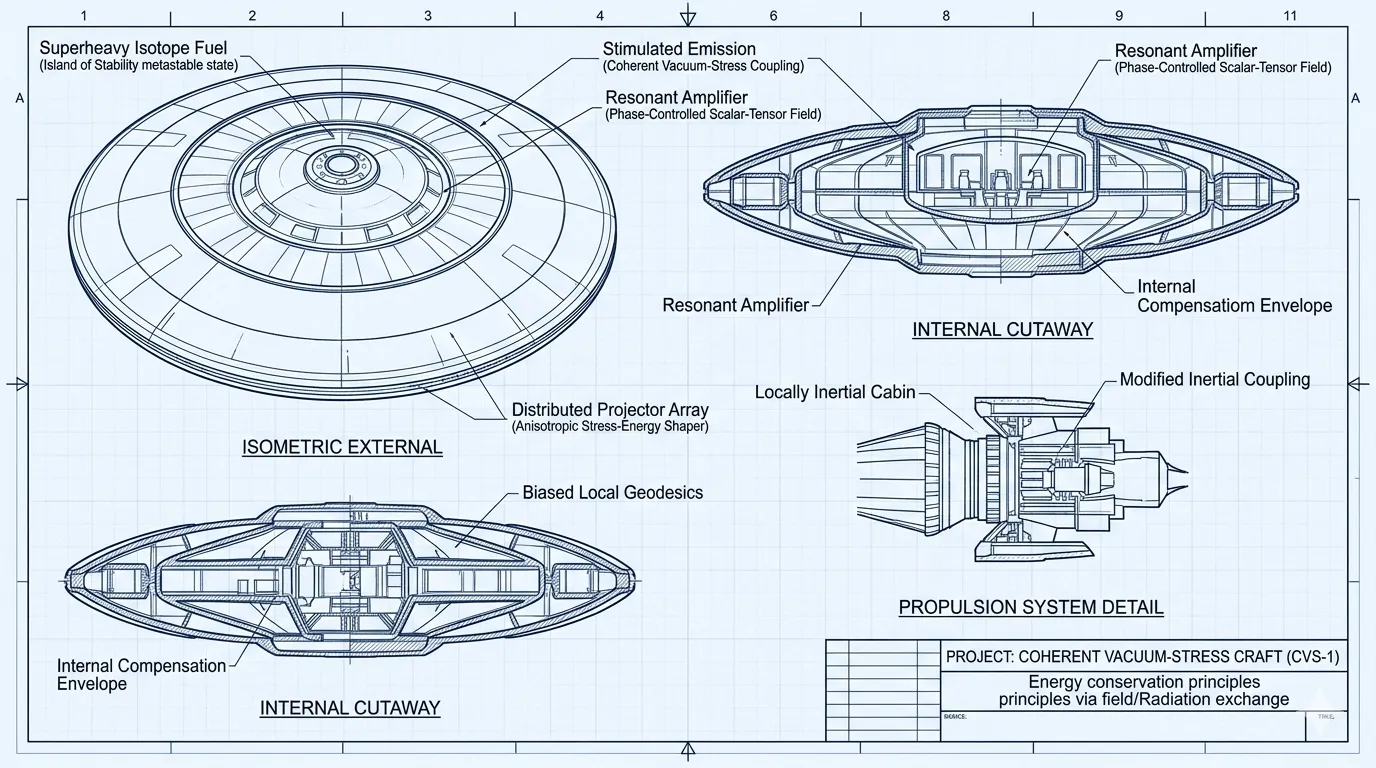
Concept illustration. The layout depicts proposed functions, not a verified engineering design.
Begin with the known conversion chain
In nuclear thermal propulsion, reactor heat raises the temperature of propellant that is then expelled. In nuclear electric propulsion, heat is converted into electrical power for electric thrusters. NASA’s explanation of space nuclear propulsion describes these mechanisms.
The conceptual chain is:
nuclear energy → heat → propellant or electricity → thrustThe proposal examined here would require another chain:
nuclear excitation → hypothetical coherent field
                   → controlled stress-energy distribution
                   → measurable effect on motion
Every arrow in that second chain needs a physical account. Nuclear energy density alone does not establish the proposed field or explain how a vehicle would exchange momentum.
State what relativity provides
General relativity relates spacetime geometry to stress-energy. Energy, momentum, and pressure contribute to that relationship, as summarized by the Max Planck Institute’s Einstein Online explanation.
The existence of that relationship does not establish a practical means of producing a useful, controllable metric change around a vehicle. A proposal must specify the source, field equations, boundary conditions, and energy requirements.
Calling an effect “inertial compensation” also leaves work to do. The model would have to show how motion and forces differ inside and outside the proposed region, rather than assume a protected cabin as a design feature.
Define the hypothetical field without claiming a derivation
The original concept assigns scalar and tensor labels to a field, denoted Φ:
| Label | Proposed role |
|---|---|
| Φ₀ | A scalar quantity associated with local coupling conditions |
| Φᵢⱼ | A representation of directional stress or geometry |
These labels are bookkeeping. They do not specify a scalar–tensor action or derive a solution. A scalar field can have spatial gradients and contribute anisotropic stress, so directionality alone does not prove that a separate new tensor field is required.
A schematic stress-energy decomposition is:
T_total = T_matter + T_EM + T_radiation + T_ΦHere, T_EM represents electromagnetic contributions and T_Φ is the proposed additional contribution. A consistent theory must define that last term and how it interacts with the others. Writing it into a sum does not demonstrate that it exists.
The Casimir-effect literature describes measurable forces associated with constrained physical configurations. It provides a reason to study boundary conditions carefully. It does not establish the nuclear coupling or vehicle propulsion proposed here.
Specify the missing source physics
The concept assumes a hypothetical stable or metastable superheavy isotope. This assumption must remain separate from what has been measured for moscovium.
The proposed source would need accessible excitation energy, a controlled release pathway into Φ, and a coupling large enough to produce a measurable effect. None of those properties is established for the proposed material.
The original shorthand can be retained as:
S_115 = η × ρ_n × C_nv| Symbol | Intended meaning |
|---|---|
| S_115 | Proposed source strength |
| η | Excitation efficiency |
| ρ_n | Available nuclear energy density |
| C_nv | Hypothetical coupling coefficient |
The expression is not yet a predictive equation. Units, normalization, and an operational definition of source strength are missing. Comparing C_nv numerically with gravitational coupling would also require compatible definitions and dimensions.
A physical model must establish what is measured, how the variables are related, and which observations constrain the proposed coefficient.
Treat coherence as a requirement to demonstrate
The imagined architecture routes a source through mode selection and phase control:
hypothetical source → mode selection → phase-controlled distribution
                    → proposed projector array
One possible notation for an oscillating output is:
Φ_i(t) = A_i cos(ωt + φ_i)Here, A_i is amplitude, ω is angular frequency, and φ_i is the phase at element i. This is a familiar mathematical form for an oscillation. It does not show that Φ can be generated, sustained, or coupled to motion.
Likewise, the proposed gain expression,
G = Φ_output / Φ_seedrequires a definition of the amplitudes and measurement conditions. An amplifier must draw energy from a reservoir. A large amplitude ratio cannot establish energy gain without accounting for the complete system.
Loss of coherence would be an operating condition to model. Its consequences cannot be specified confidently while the field and source remain hypothetical.
Read the projector layout as an illustration
The original concept proposed twelve radial elements, three lower elements, six secondary elements, and one central component. Those counts illustrate how functions might be distributed. They do not follow from a field solution.
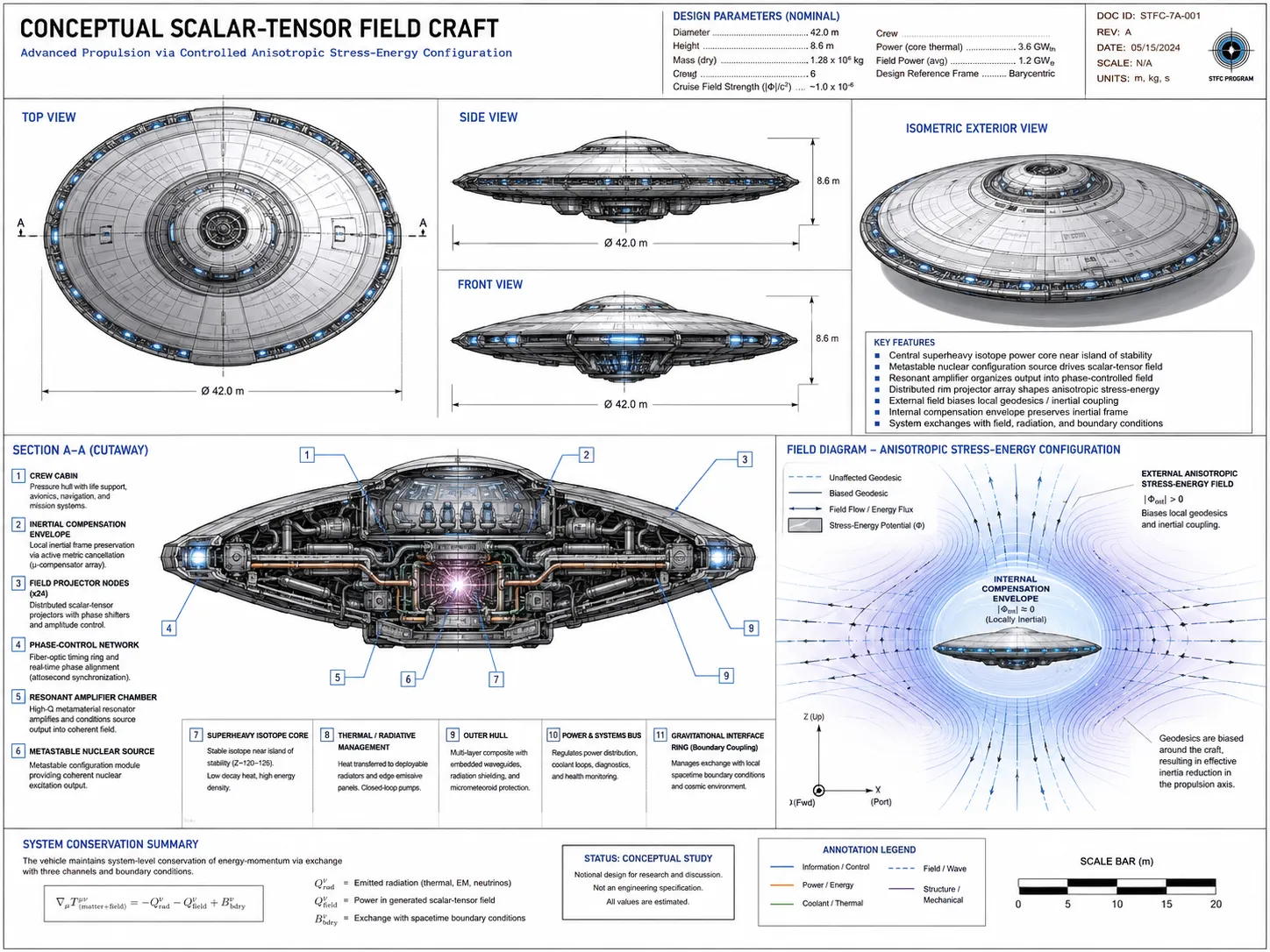
Concept illustration. The labeled components have no demonstrated implementation in this model.
The radial portion is sketched below:
          P12     P1      P2
      P11                 P3

   P10         [CORE]         P4

      P9                  P5
           P8     P7    P6
The phased-array analogy suggests a question about how multiple sources might shape a field. It cannot supply the missing interaction. A useful next calculation would need to derive what a given source configuration produces and whether that result satisfies the governing equations.
Require conservation and a measurable prediction
A candidate theory must account for energy and momentum in the vehicle, fields, radiation, and any external interaction. For a relativistic formulation, local stress-energy conservation must be consistent with the field equations. Renaming a force as a metric effect does not remove that requirement.
Before a vehicle architecture could be evaluated, the proposal would need a quantitative prediction: a defined excitation produces a specified signal under stated conditions. The prediction must also distinguish the proposed effect from heating, electromagnetic forces, vibration, radiation pressure, and measurement error.
The corresponding test needs controls, an uncertainty budget, and independent replication. These are requirements for evaluating the hypothesis, not a claim that an experiment or suitable source material already exists.
Identify the next meaningful step
The concept currently lacks a validated material, interaction, field theory, and measured propulsion effect. Its equations and diagrams help identify those gaps.
The next useful step would be to define a dimensionally consistent coupling and derive a falsifiable prediction compatible with existing observations. If that cannot be done, additional vehicle detail will not resolve the central problem: how the proposed source would produce the claimed motion.
Share this article

yankee0one
Scientific research analyst focused on the convergence of artificial intelligence, complex systems, and cyber defense.
Related Articles
The Geometry of the Unknown: A Collective-Motion Approach to UAP
A corrected collective-motion analysis of UAP imagery: formation measurements from Videos 718 and 782, with Video 709 treated as a brief transient pending dedicated tracking.
Read more
Connections and Emergence: Mathematics Behind Networked Systems
How weighted connections, optimization, and feedback help explain collective behavior in neural networks and inform questions about cyber defense.
Read more
Rules of Life: Simulating Evolution in a Shifting World
An illustrative model of how resource scarcity, mutation, and environmental change affect survival, with limits on what the reported results establish.
Read more